

I can only speculate on the reasons. But the signals from Washington are clear: by supporting far right parties in Western Europe, which, to the delight of the Russian dictator, to varying degrees all appeal to voters’ anti-EU sentiments, the attempt is clearly to break up the European Union and prevent any wider and deeper integration of the continent – which in the future might include the UK again, Switzerland, Norway, the Balkans, but also at some point Ukraine and Belorussia.
Western Europe is a populous and rich region and could play a much larger role in geopolitics if it got its act together: its population (excluding Ukraine and Belorussia) is in the order of 550 million while there are just about 340 million Americans. In other words, on this basis it is more than 60 percent larger than the US. Historically, the policy of a hegemon (such as the US today) has often been to “divide et impera”, ie, prevent the adversaries to unify. European countries on their own are powerless but united they would be a force to be reckoned with. In purchasing power parity terms, western Europe’s gross domestic product is about 16 percent larger than that of the US, though 13 percent smaller than China’s, the world’s largest economy (the gap keeps widening).
Europe’s democracies are also an attractive role model for the rest of the world. All are characterized by the rule of law, strong social safety nets, free education, affordable health care, a solid infrastructure, a relatively fair distribution of income and wealth, no ambition to expand their territories (after the end of colonialism 70 years ago), free media, the absence of capital punishment. Looking at the illiberal developments in Trump’s United States these days, Europe is the new land of the free.
But it is obviously weak in geopolitical terms and continues to rely on the US for protection. Aside from being anything resembling a nation state with common fiscal and military policies, Europe also suffers from slow economic growth and somewhat higher unemployment than China and the US. The EU’s real GDP per capita has increased at an average rate of 1.16 percent over the past twenty years, compared to America’s 1.29 percent and China’s 7.16 percent (!). Population growth has been close to zero, with a fertility rate of just 1.38 and thus well below 2.1, the rate needed to stabilize the size of the population in a long-term equilibrium. Population keeps expanding mainly due to rising life expectancy and net immigration.
Population trends mean that the financial burden on Europe’s younger generations is rapidly becoming unbearable and threatening social cohesion and democracy itself. Far right-wing parties are on the rise. This is a development that is probably very much appreciated by the present government in Washington.
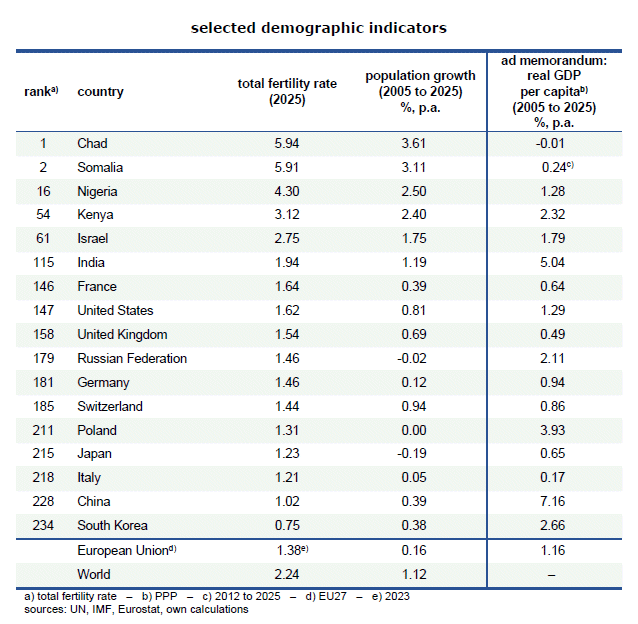
According to Mr Trump’s recent 32-page National Security Strategy (NSS) paper, Europe is heading to “civilizational erasure”, mostly because of mass immigration of non-Europeans, and is almost irrelevant as a player on the world stage. To put this into perspective, on page 25 of the NSS text it says, “continental Europe has been losing share of global GDP – down from 25 percent in 1990 to 14 percent today – partly owing to national and transnational regulations that undermine creativity and industriousness.” “Continental Europe” probably stands for the EU27. According to the International Monetary Fund (IMF), the comparable numbers for the United States are 22 and 15 percent and thus not so much different. Looks like the US is also heading towards irrelevance.
While becoming a geopolitical player is not the most important goal for the European Union, in order to defend itself, not only militarily but also in future trade wars, economic growth must accelerate. Some centralization of power is clearly necessary. A process in this direction has been under way for decades now, but it remains very slow and is far from the point where it should end – it is not easy to align the interests of 27 countries (western Europe consists of 35 countries).
To move to a steeper economic growth path, Europe must urgently do two things: increase the potential labor force by lengthening the average working life, raising the labor force participation rate of women and stimulating the immigration of (skilled) labor on the one hand, and, on the other hand, boost productivity growth via better education, a stronger emphasis on research and development and a removal of barriers to competition (without giving up social safety nets).
What continues to be lacking is a sense of urgency. In the past, European unification used to intensify in the face of crises and outside pressure. Given the technological revolutions and the expansionary ambitions of the American, Russian and Chinese governments, such a moment has arrived once again.
About Wermuth Asset Management
Wermuth Asset Management (WAM) is a Family Office which also acts as a BAFIN-regulated investment consultant.
The company specializes in climate impact investments across all asset classes, with a focus on EU “exponential organizations” as defined by Singularity University, i.e., companies which solve a major problem of humanity profitably and can grow exponentially. Through private equity, listed assets, infrastructure and real assets, the company invests through its own funds and third-party funds. WAM adheres to the UN Principles of Responsible Investing (UNPRI) and UN Compact and is a member of the Institutional Investor Group on Climate Change (IIGCC), the Global Impact Investing Network (GIIN) and the Divest-Invest Movement.
Jochen Wermuth founded WAM in 1999. He is a German climate impact investor who served on the steering committee of “Europeans for Divest Invest”. Jochen was on the founding investment committee of Germany’s SWF KENFO from June 2017 until February 2024.
Legal Disclaimer
The information contained in this document is for informational purposes only and does not constitute investment advice. The opinions and valuations contained in this document are subject to change and reflect the viewpoint of Wermuth Asset Management in the current economic environment. No liability is assumed for the accuracy and completeness of the information. Past performance is not a reliable indication of current or future developments. The financial instruments mentioned are for illustrative purposes only and should not be construed as a direct offer or investment recommendation or advice. The securities listed have been selected from the universe of securities covered by the portfolio managers to assist the reader in better understanding the issues presented and do not necessarily form part of any portfolio or constitute recommendations by the portfolio managers. There is no guarantee that forecasts will occur.
Read the full article in PDF format here: English.