Going by the OECD’s recent forecasts, the world’s real GDP continues to expand briskly at a rate of around 3%. This is also the consensus among economists who work for research institutes or banks. The main drivers of growth are China and India, other emerging economies such as Brazil, Mexico, Indonesia and the rest of East Asia, as well as Nigeria or Poland; they are all in catching-up mode, characterized by large productivity gains which in turn are a result of low wages, capital inflows and their rapid integration into international supply chains. For the world as a whole, the division of labor across borders is still alive and well. Western Europe and Japan are more or less stagnating – for seven years now – and thus pull down the global average. At the same time, the US, with expected growth rates in the order of 2%, show that even in mature economies robust productivity gains are possible if the conditions are right. On balance, though, the share of rich OECD countries in global output keeps shrinking. They remain rich nonetheless.
But there are several risks that suggest that the future will be less benign than presently expected.
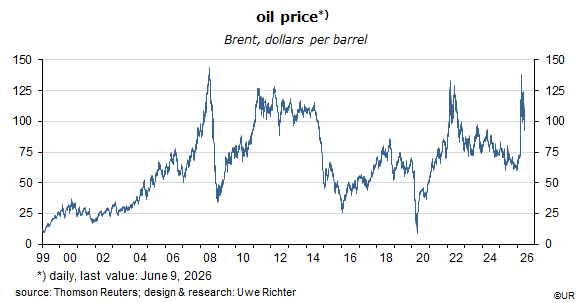
One is the high oil price. If we assume that the war against Iran cannot be won quickly and decisively, given that the US administration will not “put a sufficient number of boots on the ground”, oil prices will remain high: Brent was 60 dollars a barrel at the beginning of the year and is now at 95 dollars, after a high of more than 130 dollars in April. Under the assumption that today’s oil price is the “new normal” the negative impact of these high prices on the global economy will be significant: real disposable incomes in oil importing countries are being hit hard. Both consumers and business are affected. The former will spend less on non-energy items as real wages are beginning to stagnate or fall while the latter will revise down their capital spending and hiring plans. Output gaps will widen – which has deflationary effects in the longer run.
Even so, actual inflation is on the rise. In the euro area, headline inflation has reached 3.2% year-on-year, and 3.8% in the US. For comparison, the central banks of both economies have 2% inflation targets. US producer prices were up 4.9% year-on-year in April, an ominous sign for consumer prices there. For market participants it is more or less a done deal that both the Fed and the ECB will raise their key policy rates by 25 basis points this month, to 4% and 2¼% respectively. Money market rates and bond yields will rise further – which has predictably a negative impact on the economy.
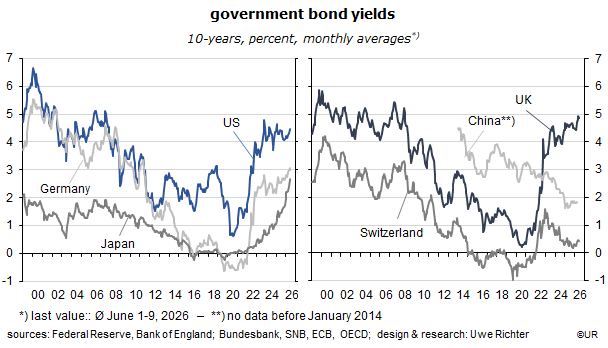
So final demand in the two largest OECD economies is about to weaken while inflation is on the rise. This is called stagflation. It implies that monetary policy makers have almost no options at this point; they cannot lower interest rates while, on the other hand, governments cannot do much to stimulate their economies either – fiscal budget deficits are already very large and are bound to increase as economic growth slows.
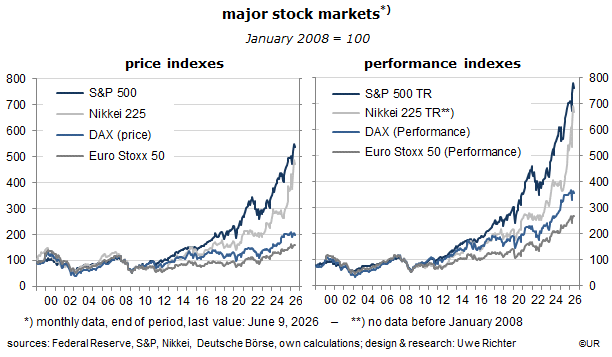
Another significant risk is overvalued assets. Prices of US and Japanese equities in particular have increased a lot more than nominal GDP in recent years and are close to their all-time highs, which does not only mean that the remaining upside potential must be small but also that profit taking will become an increasingly attractive strategy. Bad economic news, as stagflation starts to bite, will probably be the trigger for the coming stock market correction. In other economies such as China and Western Europe stock market valuations are less extreme than in the US and Japan, but they are also quite elevated. In other words, a sell-out in the two most exposed countries, the US and Japan, could quickly spread to other regions of the world.
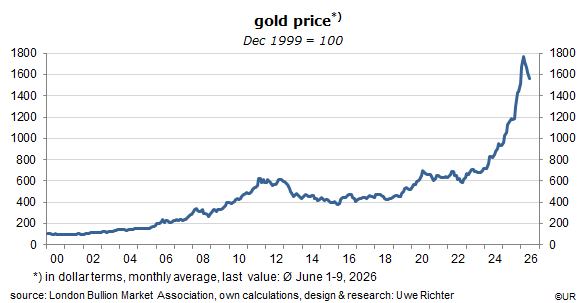
Is there a place to hide? Gold certainly isn’t one of them. Its dollar price has increased by no less than 250% over the past ten years and is thus rife for a major setback once it becomes clear that the world economy is slowing, or may actually be heading toward recession. Deflation will then become a more likely scenario than inflation. No need to buy gold to hedge against inflation.
Crypto currencies are also going to experience their day of reckoning – market forces will show that most of them are just hot air, without any backing by real assets or central banks. They are likely candidates for profit taking, which would be another negative wealth effect on final demand.
As if all this were not enough, artificial intelligence will increasingly wipe out lots of jobs, not least in manufacturing and finance, even in law. AI may boost productivity and income over time, but near term there will be a significant increase in so-called frictional unemployment. The transition from here to there will be painful.
The above recession scenario has a bright side: high oil and gas prices and weak overall demand will reduce the emission of CO2 and other greenhouse gases and thus help to improve the climate. Green investments now make even more sense than before. It is not obvious, though, that this will be a lasting effect: after all, the coming recession will probably lead in the end to a large decline of fossil fuel prices and thus provide a big boost to the demand and consumption of the stuff. In any case, the year 2026 and probably the year 2027 as well will show large, if temporary reductions in emissions.
Near term, a good place to be for financial investors are shares of oil and gas producers, and utilities. Their profit margins have exploded. Later on, of course, they should be traded on the short side: recessions are negative for the prices of fossil fuels.
The main protection against the risks described above is to raise the share of liquidity in portfolios, not least because the main central banks have obviously decided to raise policy rates. Short-term liquid assets are the place to be in the near term.
About Wermuth Asset Management
Wermuth Asset Management (WAM) is a Family Office which also acts as a BAFIN-regulated investment consultant.
The company specializes in climate impact investments across all asset classes, with a focus on EU “exponential organizations” as defined by Singularity University, i.e., companies which solve a major problem of humanity profitably and can grow exponentially. Through private equity, listed assets, infrastructure and real assets, the company invests through its own funds and third-party funds. WAM adheres to the UN Principles of Responsible Investing (UNPRI) and UN Compact and is a member of the Institutional Investor Group on Climate Change (IIGCC), the Global Impact Investing Network (GIIN) and the Divest-Invest Movement.
Jochen Wermuth founded WAM in 1999. He is a German climate impact investor who served on the steering committee of “Europeans for Divest Invest”. Jochen was on the founding investment committee of Germany’s SWF KENFO from June 2017 until February 2024.
Legal Disclaimer
The information contained in this document is for informational purposes only and does not constitute investment advice. The opinions and valuations contained in this document are subject to change and reflect the viewpoint of Wermuth Asset Management in the current economic environment. No liability is assumed for the accuracy and completeness of the information. Past performance is not a reliable indication of current or future developments. The financial instruments mentioned are for illustrative purposes only and should not be construed as a direct offer or investment recommendation or advice. The securities listed have been selected from the universe of securities covered by the portfolio managers to assist the reader in better understanding the issues presented and do not necessarily form part of any portfolio or constitute recommendations by the portfolio managers. There is no guarantee that forecasts will occur.
Read the full article in PDF format here: English.