

Mainz, September 21, 2026 │ Dieter Wermuth
During the one-and-a-half decades leading up to 2002, the price of Brent crude oil had fluctuated closely around 20 dollars, followed by several wide swings, in a range between 25 and 130 dollars and an average of around 73 dollars, driven by the wars in the Near East and Ukraine, the Corona pandemic and the global financial crisis of 2007/2008. Euphoria and panic followed each other in short order. At the beginning of this year the world market price was about 60 dollars, historically already a very high level, and has in the meantime increased to 103 dollars. There has been no clear trend.
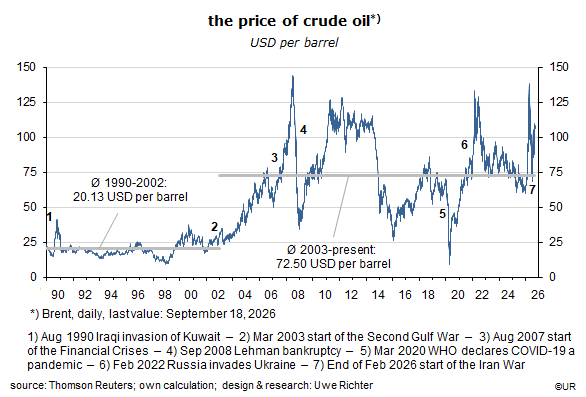
For an economist 20 dollars are the most plausible price at which demand for and supply of oil would meet in the long run. It could be something of an equilibrium price. Today’s price of 103 dollars per barrel would therefore be far above anything that can be regarded as “normal”. The question is whether it will move in the direction of 20 dollars again once peace returns to the Near East and the next US administration pursues less erratic policies.
It is perhaps too ambitious to define a global equilibrium price for oil – we should more modestly just answer the question whether crude is expensive or cheap at this point. It is rather expensive compared to its average price in recent decades, and extremely expensive compared to the fifties and sixties when prices of 2 to 3 dollars were normal. Crude oil is a scarce and finite resource: demand grows year after year, much faster than new supply from exploration.
For countries which are net importers of oil, high and rising prices mean that real incomes shrink or grow more slowly than usual – overall, import prices rise faster than export prices of non-energy goods and services. Households and businesses must reduce their non-oil purchases, or raise them at a slower pace than in the past. The larger the dependence on oil imports the larger the negative effect on the economy. This is the so-called terms-of-trade effect on real GDP.
Since, from a global perspective, this is a zero-sum game, the net exporters of oil (and natural gas) are the big winners, especially the United States, Iran and the other countries around the Persian Gulf, Nigeria, Venezuela, Norway and last not least Russia. The international income distribution has changed a lot over the course of the oil price inflation. Losers have been the European Union, China, Japan, South Korea and all other countries which are net importers of oil.
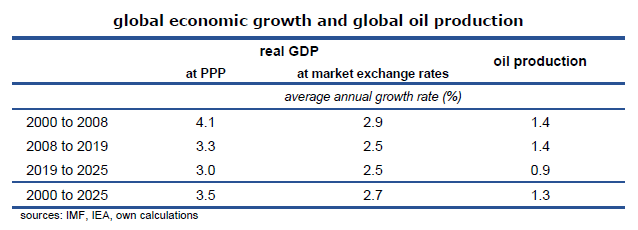
Another, though underrated effect: rising prices of fossil fuels are good news for those who worry that the earth may be heating up too fast. Rising CO2 emissions and rising temperatures are mainly caused by the fact that year after year the world continues to burn ever larger amounts of oil and natural gas. An end of this process is not in sight. Over the past twenty years, the world economy has grown more or less steadily at a rate of 3 percent annually (GDP at purchasing power parities) while oil production has expanded at an equally steady rate of almost 1 ½ percent.
The goal is obviously to reduce (not just slow) the emission of greenhouse gases. Even higher prices for fossil fuels are needed, and soon. To achieve this in a socially acceptable manner will be a major challenge for policy makers.
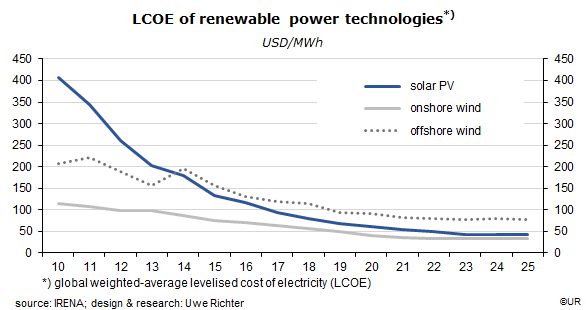
A bright spot is the fact that the world economy has begun to electrify surprisingly fast and that electricity from alternative (“green”) sources is getting cheaper than from fossil fuels, both in absolute and relative terms. The production cost of green electricity is already lower than that from nuclear power, including from power plants which have already been depreciated more or less fully.
To be realistic, we have to assume that the climate will deteriorate further over the coming decades.
And the bottom line? Is the world market price of oil high or not?
In recent years political events and developments were the main determinants. If the wars in the Near East and Ukraine continue and perhaps even intensify, supply chains will break which could possibly lead to a doubling of oil prices. On the other hand, the deterioration of the climate could force even deniers such as the US or Russia to raise taxes and fees on oil significantly and to provide the necessary electrification infrastructure. Banning the burning of oil and gas could be an additional measure. This would reduce the demand for fossil fuels and lower their world market prices. In the long run, the demand for oil and gas will almost automatically decline as unbeatably cheap „green” energy gains market shares. Green hydrogen may also finally become an alternative source of energy.
Another question is whether the oil market is heading towards a Minsky moment: when prices have increased quickly and briskly for a long time (as in recent years), they may arrive at a point where further price gains appear increasingly unlikely – because, for example, central banks, worrying about inflation, start to raise policy rates. Investors are also aware that markets will not allow unlimited price inflation. A switch to money market instruments and bonds would follow, as well as profit taking in all sectors related to oil, followed by panic and a crash. The oil price could fall to 20 dollars again in such a scenario.
I think that a further near-term increase of oil prices is certainly a major risk, but for the reasons explained above the longer-term price will be well below today’s 103 dollar. Oil is expensive.
About Wermuth Asset Management
Wermuth Asset Management (WAM) is a Family Office which also acts as a BAFIN-regulated investment consultant.
The company specializes in climate impact investments across all asset classes, with a focus on EU “exponential organizations” as defined by Singularity University, i.e., companies which solve a major problem of humanity profitably and can grow exponentially. Through private equity, listed assets, infrastructure and real assets, the company invests through its own funds and third-party funds. WAM adheres to the UN Principles of Responsible Investing (UNPRI) and UN Compact and is a member of the Institutional Investor Group on Climate Change (IIGCC), the Global Impact Investing Network (GIIN) and the Divest-Invest Movement.
Jochen Wermuth founded WAM in 1999. He is a German climate impact investor who served on the steering committee of “Europeans for Divest Invest”. Jochen was on the founding investment committee of Germany’s SWF KENFO from June 2017 until February 2024.
Legal Disclaimer
The information contained in this document is for informational purposes only and does not constitute investment advice. The opinions and valuations contained in this document are subject to change and reflect the viewpoint of Wermuth Asset Management in the current economic environment. No liability is assumed for the accuracy and completeness of the information. Past performance is not a reliable indication of current or future developments. The financial instruments mentioned are for illustrative purposes only and should not be construed as a direct offer or investment recommendation or advice. The securities listed have been selected from the universe of securities covered by the portfolio managers to assist the reader in better understanding the issues presented and do not necessarily form part of any portfolio or constitute recommendations by the portfolio managers. There is no guarantee that forecasts will occur.
Read the full article in PDF format here: English.