
Mainz, October 26, 2026 │ Dieter Wermuth
For the participants of financial markets the risk that the euro may come under pressure once again has clearly increased over the past weeks. They worry about the situation in France. Yield spreads over German Bunds have increased steeply.
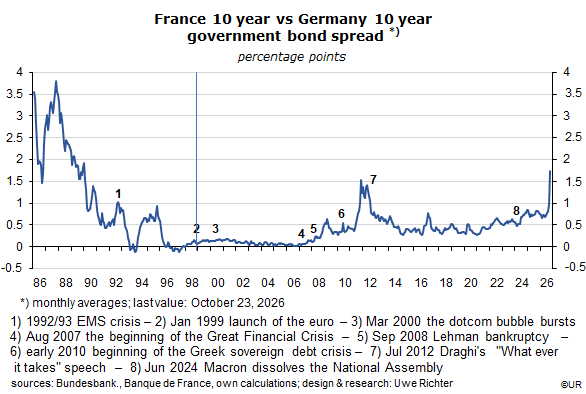
The economy of the euro area as a whole is fairly sound, going by the unemployment rate, the balance on current account, the aggregated government budget deficit and debt, and inflation, not least in comparison to the UK or the United States.
But investors are not impressed. They focus on the street battles in France these days (so far without any fatalities). Looting and mass arrests dominate the news. The protests started when high school students demonstrated for a better education environment, followed by university students and unemployed young men from the poorer suburbs who are pessimistic about their future – will they ever get safe and well-paid jobs, as their parents before them?
In the meantime, the unrests have reached some other countries in the south of the continent: Italy, Spain and Greece.
“La vie chère”, the cost of living, has now become the major issue of the French demonstrations (yesterday there were between 400 to 800 thousand participants on the streets, depending on the source), even though inflation is still not only moderate but somewhat lower than in the rest of the European Union. Trump and his war against Iran are the main culprits for the large increase in gas and diesel prices, rather than the French government. But Trump is far away. He gleefully recommends, not that anybody had asked him, that France close its borders, as if immigrants from the Maghreb and other African regions were the main reason for the fights between protesters and the police. Xenophobic declarations supposedly help Trump in the upcoming midterm elections. But the issue of immigration actually plays no role on the French streets these days. It’s the children of the French middle class, not foreigners, who are demonstrating.
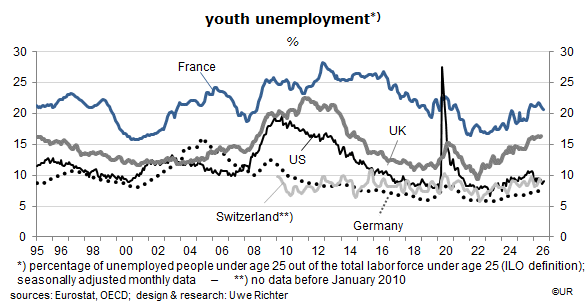
The main near-term problem is that France will not be able to meet the so-called Maastricht criteria of the currency union. Public sector budget deficits have been, and will remain, near 5 percent of nominal GDP, compared to a target of 3 percent or less, while public sector debt has reached 119 percent of GDP – it is thus almost exactly twice as high as it should be. This means that the government has very little room for maneuver and has to pursue austerity policies. In other words, it is unable to cut taxes, for instance to lower the prices of fossil fuels paid by consumers and business, nor can it significantly increase spending. For many people in France, Maastricht and the euro have led to a loss of fiscal autonomy. The government appears paralyzed.
To make matters worse, the administration is no longer able to depreciate the exchange rate in order to improve the country’s price competitiveness. France has neither an own currency nor an own sovereign monetary policy any more. Policy rates are determined in Frankfurt, at the ECB. It is thus no surprise that the euro is seen as the main culprit for the various economic problems of France. I wonder why most citizens in the rest of the currency union have no problem about euro membership. Why in France?
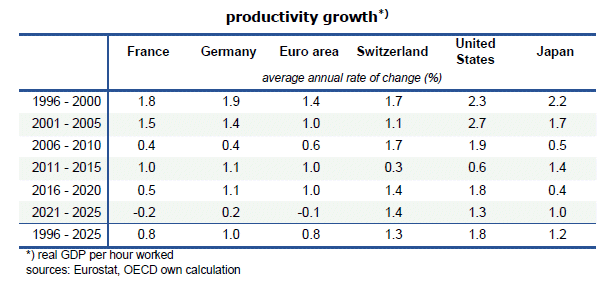
Although the growth rates of real GDP were higher in France than in Germany, the performance of labor productivity (on a per-hour basis) was worse over the past ten years. Since 2021 productivity growth in both countries has not been significantly different from zero and well below US growth rates. On the other hand, going by the balance on current account, the French deficit (of about 0.7% of GDP) is quite small which could be interpreted that international price competitiveness is not so bad after all (the US deficit is at almost 4% of GDP).
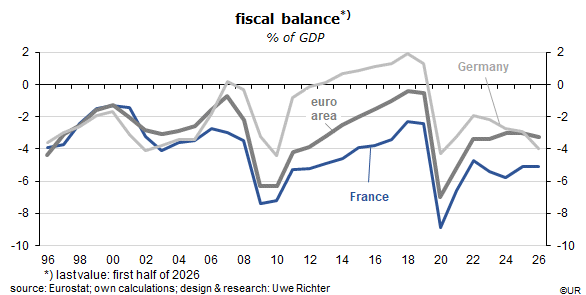
Capital markets are not impressed by these relatively sound economic fundamentals. They focus on the poor situation of public finances, the weakness of the government, and high youth unemployment. They expect that rating agencies will continue to downgrade French debt, even though Moody’s has just left the rating unchanged at Aa3 (with a negative outlook, October 23). French assets are seen as risky. It is for this reason that the euro exchange rate has been relatively weak this year.
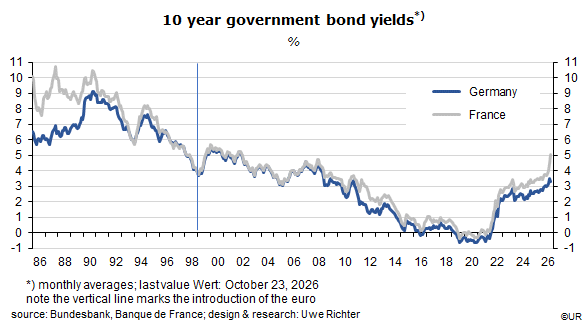
At this point in time, the yields of Italian, Spanish and even Portuguese and Greek longer-term government bonds are lower than French ones. Many investors regard France as the new sick man of Europe.
Going by today’s French media, the euro is increasingly the culprit for the country’s economic problems, more precisely the German diktat which it supposedly represents. Both the extreme right, led by Marine Le Pen (surveys expect her to become the next president), and the radical left (Jean-Luc Mélenchon’s France Insoumise) blame a large part of the French troubles on Germany and Brussels and promise to strengthen the country’s autonomy if they win next spring’s elections.
Meanwhile the political center is shrinking, just as in Germany. There is no politician who would vigorously and credibly fight for the European project and its liberal values. President Emmanuel Macron is unpopular, but remains in office until next May. He is seen as arrogant, aloof, and know-it-all. A plausible successor who can turn around things is nowhere in sight. The main objective of politicians today is to just avoid too much damage.
So how will all this end? In my optimistic and perhaps naïve view, the French society will realize in the coming months that it does not make sense to fight both Berlin and Brussels, given the dangers of the extremes on the left and right as well as Russia’s attempts to destabilize EU and NATO. This had happened before previous presidential elections. Recent surveys suggest that the Rassemblement National would get about a third of the votes in the first round – so there is still a majority among voters for moderate and left-wing parties.
A coalition against Le Pen’s Rassemblement National is not at all a done deal, though. Animosities between the many presidential contenders still run high. For now, investors need a lot of courage to bet on a recovery of French bonds and the euro. It would be a bet on a stable France. But yields are certainly attractive while the assumption is not unrealistic that France will get its public finances under control and will not be forced to leave the euro.
The correction that is under way on stock markets also suggests that inflation risks are about to decline, meaning that expected real bond yields will soon be lower than today – which is positive for French bonds. I have no doubt that France will be able to service its debt, one way or another, in spite of weak economic growth.
About Wermuth Asset Management
Wermuth Asset Management (WAM) is a Family Office which also acts as a BAFIN-regulated investment consultant.
The company specializes in climate impact investments across all asset classes, with a focus on EU “exponential organizations” as defined by Singularity University, i.e., companies which solve a major problem of humanity profitably and can grow exponentially. Through private equity, listed assets, infrastructure and real assets, the company invests through its own funds and third-party funds. WAM adheres to the UN Principles of Responsible Investing (UNPRI) and UN Compact and is a member of the Institutional Investor Group on Climate Change (IIGCC), the Global Impact Investing Network (GIIN) and the Divest-Invest Movement.
Jochen Wermuth founded WAM in 1999. He is a German climate impact investor who served on the steering committee of “Europeans for Divest Invest”. Jochen was on the founding investment committee of Germany’s SWF KENFO from June 2017 until February 2024.
Legal Disclaimer
The information contained in this document is for informational purposes only and does not constitute investment advice. The opinions and valuations contained in this document are subject to change and reflect the viewpoint of Wermuth Asset Management in the current economic environment. No liability is assumed for the accuracy and completeness of the information. Past performance is not a reliable indication of current or future developments. The financial instruments mentioned are for illustrative purposes only and should not be construed as a direct offer or investment recommendation or advice. The securities listed have been selected from the universe of securities covered by the portfolio managers to assist the reader in better understanding the issues presented and do not necessarily form part of any portfolio or constitute recommendations by the portfolio managers. There is no guarantee that forecasts will occur.
Read the full article in PDF format here: English.