

Mainz, October 7, 2026 │ Dieter Wermuth
Recently, someone has claimed that, given the choice, buyers of German securities can’t go wrong if they always prefer stocks over bonds, no matter when they buy. But, as the numbers in the table show: the recommendation is not backed by the facts. Bonds are sometimes the better choice.
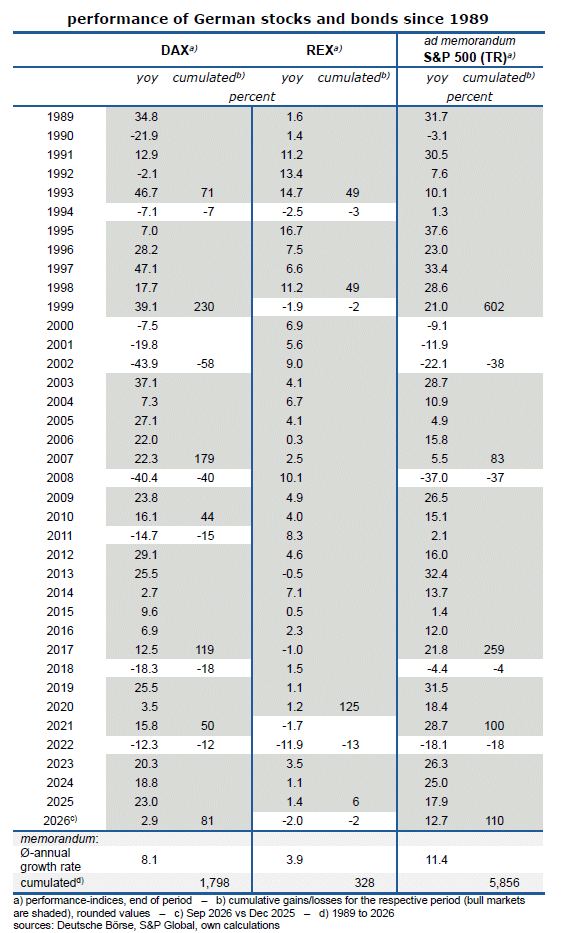
The main message that can be derived from the table: it has been very expensive to buy stocks near the end of a rally. Not long after that point in time stock prices regularly declined, more or less steeply. In the 38 years covered, there had been six broad-based setbacks of Germany’s stock market performance index. They ranged between 7 and 58 percent: the stronger and longer the previous rally, the larger the subsequent setback. Similar observations can be made on the US stock market. It seems we are looking at a universal rule here.
In Germany, stock market rallies have typically lasted five or six years, invariably followed by falling stock prices. If the stock market follows this pattern once again, it will probably come down within the next two years. Over the course of the baisse, buying opportunities will improve significantly, especially during its later stages when investor sentiment is at its most negative.
The average annual performance of the German stock market during those 38 years had been 8.1%, compared a growth rate of just 3.9% for government bonds (“Bunds”). This means that on average stocks had a so-called risk premium of a little more than four percentage points. Averages are often deceiving, though: investors who bought stocks during the last year of a hausse, carried away by the general euphoria that prevails at the time, have not profited from the risk premium. This is just common sense. In the longer term money is made when the market is entered at depressed prices.
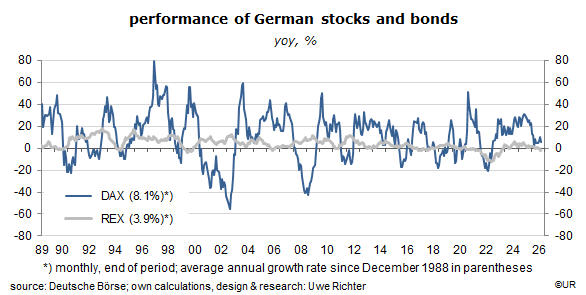
Growth rates of 8.1 and 3.9% reflect nominal values – they are partly a compensation for inflation. In real terms the performance of stocks and bonds is much less. Between December 1988 and today average annual consumer prices had increased by 2.1% which means that government bonds had not been attractive investment vehicles in purchasing power terms.
Incidentally, differences in inflation rates were one reason, though not the major one, why US stocks had fared much better than German stocks. The 38-year average of American annual inflation had been 2.8%, compared to Germany’s 2.1%, a rather small difference. The main reason for the outperformance of US stocks (on average 11.4% vs. Germany’s 8.1%) is explained by differences in the structure of the two indices – the growth rate of America’s actual and expected corporate profits has simply been far superior, especially of the dominant tech companies. These play a smaller role in the DAX.
Can the difference in performance be explained by exchange rates? In theory, stock markets of a country with a depreciating currency must do better than those of a hard currency country. But this had not been the case – on average, the dollar has depreciated against the euro (and its synthetic predecessor) by just 0.1% per year. This has been de facto a stable exchange rate.
For two main reasons, stocks carry risk premia compared to government bonds.
- Firms often leave the market when their business does not generate profits in a sustainable way. The owners of the firms – the shareholders – then lose part or all of their assets. This cannot happen to their government bonds, at least as long as the country does not enter a war which it loses. Put differently: someone who buys risky assets (stocks) will usually earn higher returns than somebody who is risk averse (a bond holder).
- Stock prices and stock indices are often very volatile. Investors can therefore not be sure that they will be able to sell their assets at or above their purchase price – or at all. As both the little graph and the table show, the risk of losing out with stocks is much higher than with bonds. It is not least because of this feature (of relatively stable price expectations) that investors accept the low returns of bond holdings.
About Wermuth Asset Management
Wermuth Asset Management (WAM) is a Family Office which also acts as a BAFIN-regulated investment consultant.
The company specializes in climate impact investments across all asset classes, with a focus on EU “exponential organizations” as defined by Singularity University, i.e., companies which solve a major problem of humanity profitably and can grow exponentially. Through private equity, listed assets, infrastructure and real assets, the company invests through its own funds and third-party funds. WAM adheres to the UN Principles of Responsible Investing (UNPRI) and UN Compact and is a member of the Institutional Investor Group on Climate Change (IIGCC), the Global Impact Investing Network (GIIN) and the Divest-Invest Movement.
Jochen Wermuth founded WAM in 1999. He is a German climate impact investor who served on the steering committee of “Europeans for Divest Invest”. Jochen was on the founding investment committee of Germany’s SWF KENFO from June 2017 until February 2024.
Legal Disclaimer
The information contained in this document is for informational purposes only and does not constitute investment advice. The opinions and valuations contained in this document are subject to change and reflect the viewpoint of Wermuth Asset Management in the current economic environment. No liability is assumed for the accuracy and completeness of the information. Past performance is not a reliable indication of current or future developments. The financial instruments mentioned are for illustrative purposes only and should not be construed as a direct offer or investment recommendation or advice. The securities listed have been selected from the universe of securities covered by the portfolio managers to assist the reader in better understanding the issues presented and do not necessarily form part of any portfolio or constitute recommendations by the portfolio managers. There is no guarantee that forecasts will occur.
Read the full article in PDF format here: English.